How Do I Minimise the Footprint of a MEG Injection Package on an FPSO?
The Bottom Line: Minimising the footprint of a new Monoethylene Glycol (MEG) injection package on an FPSO or offshore platform requires a custom engineering approach to overcome severe space constraints. You can achieve the most effective footprint reduction through four key strategies:
- Specifying vertical plunger pumps instead of traditional horizontal units.
- Utilising Finite Element Analysis (FEA) to engineer structurally optimised, low-profile baseframes.
- Engineering Modular Skid Interfaces to work around the installation limitations of both new builds and existing infrastructure.
- Implementing Efficient Design Strategy – equipment selection and design philosophy that minimises the equipment and piping required.
This footprint reduction must be achieved without compromising ATEX compliance, DNV certification, or maintenance access.
Whether you are specifying equipment for a newly constructed Floating Production, Storage, and Offloading (FPSO) vessel, a new offshore platform, or integrating into a brownfield life-extension project, deck space is a heavily constrained and expensive variable.
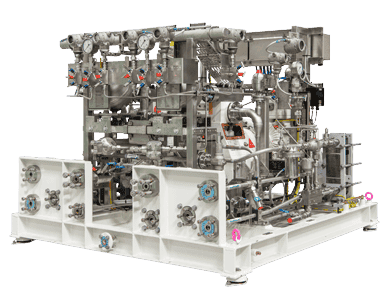
Standard MEG injection pumps often feature horizontal footprints that demand too much valuable deck space or cannot physically be routed through existing infrastructure. For lead process engineers and EPC contractors, specifying a compact, entirely new MEG or TEG package requires engineers to look at the complete package design. Here are the criteria required to minimise footprint while maintaining industry standards like API 674 and NORSOK.
1. Specify Vertical Pump Configurations
The pump and prime mover dictates the baseline footprint of the entire package. Traditional horizontal reciprocating pumps require significant deck space for both the crankcase and the necessary maintenance clearance for plunger removal.
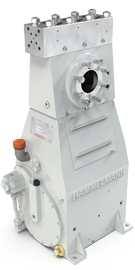
To reduce the required area, consider specification of vertical positive displacement process pumps. At Calder, we regularly integrate HamPro vertical plunger pumps into our new MEG injection packages. The vertical configuration stacks the fluid end directly above the power end. This inherently reduces the horizontal envelope, optimising deck layout on new builds and making it far easier to drop into a congested brownfield module. These units offer mechanical and volumetric efficiency up to 98% and small clearance volumes for high volumetric efficiency, ensuring that you do not have to upsize the motor to overcome mechanical losses, saving even more space.
2. Utilise FEA for Baseframe Optimisation
A pump package is only as compact as the structural steel that supports it. Over-engineered, standard-issue baseframes add unnecessary weight and bulk, which is highly problematic when dealing with the restricted load capacities of both aging offshore structures and weight-sensitive new floating platforms.
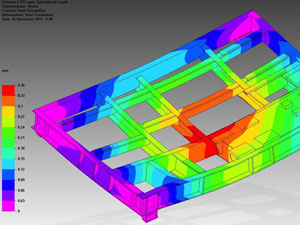
To achieve maximum space and weight savings on new packages, the skid structure must be developed using 3D CAD modeling paired with rigorously applied Finite Element Analysis (FEA), such as ANSYS Mechanical. By utilising FEA, engineers determine exactly where to locate the supporting framework for maximum strength and torsional rigidity. This removes redundant steel and reduces overall dimensions, ensuring the newly designed package still safely passes the stringent lifting cases, seismic load requirements, fatigue loading due to FPSO motion, and explosion-related ‘blast cases’ required offshore.
3. Engineering Modular Skid Interfaces
When access routes, existing deck congestion, or crane lift capacities make a single, large skid impossible to install, the footprint and unit weight must be managed through modularity.
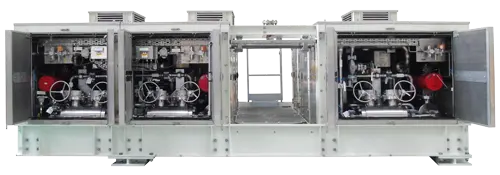
Instead of a single package, the new MEG injection system could be engineered as a multi-module solution. This involves designing the package as two or more interlocking modules (for example, separating the prime mover/pump module from the lube oil or control systems). The critical engineering challenge here is the interface between the modules. The design must focus heavily on equipment layout to ensure that when the modules are routed into position and assembled on the deck, alignment is accurate and maintenance access to key components remains unhindered.
4. Implementing Efficient Design Strategy
If the pump itself is not the bottleneck, we look at the motor. Process motors can be large and minimising the footprint requires sourcing alternative, compact motors that still meet the required hazardous area classifications. A particularly notable project for a small-skid-footprint well service pump utilised both a compact motor and a shorter coupling to achieve the customer’s limited footprint.
Additionally, the skid length can be reduced by specifying specialised, high-torque shaft couplings. In past Calder projects, sourcing highly specific ATEX-compliant couplings has allowed us to reduce the overall length of the drivetrain by up to 900mm compared to standard configurations, a critical saving for any offshore installation.
Backed by Rigorous Testing
Reducing the footprint of a high-pressure, ATEX Zone 1 or Zone 2 MEG injection package cannot come at the expense of reliability, nor can it compromise acoustic safety through excessive noise emissions. Compact layouts can introduce complex harmonic and pulsation challenges. Therefore, any compact design must be strictly validated. At our dedicated pump testing facility in Worcester, UK, we routinely perform full mechanical run tests. We also carry out DA2 (Design Approach 2) studies on our compact MEG packages to model and analyse the acoustics of the pump system and pipework. This contributes to ensuring safe, continuous duty in the field.
Contact Us
To discuss footprint reduction for your next offshore chemical injection project, contact the Calder engineering team to explore bespoke modular solutions. Please call +44 1905 751790 or email sales@calder.co.uk.