How Do I Ensure Zero-Emission Seal Containment on Hydrogen, Ammonia, and Methanol Pumps?
The Bottom Line: Ensuring zero-emission seal containment on high-pressure pumps handling hydrogen, green ammonia, or methanol requires moving beyond standard plunger packing configurations. You can achieve absolute containment by:
- Specifying Hammelmann HamPro Pumps equipped with specialised dynamic sealing technology.
- Integrating Pressurised Barrier Fluid Systems directly into the Calder pump skid.
- Selecting Specific, Advanced Metallurgy across the entire package to prevent embrittlement and corrosion.
- Utilising Magnetic Drive Pumps where applicable to eliminate external dynamic seals and reduce potential leak paths.
- Inert Gas Blanketing of Controlled Leakage
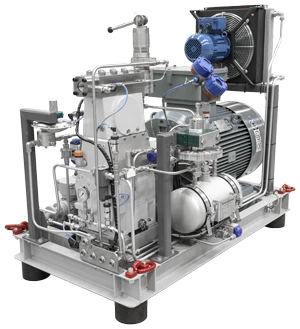
When pumping highly volatile or toxic fluids at extreme pressures, standard reciprocating pump packing will inevitably leak. For lead engineers and EPC contractors, a microscopic leak of hydrogen, ammonia, or methanol is not just an efficiency loss – it is a critical safety and environmental compliance failure.
Specifying a bare-shaft pump that claims low emissions is rarely enough to guarantee safety on site. To achieve true zero-emission containment, Calder engineers the entire pump package to isolate the process fluid. Here is the engineering criteria required to design a safe, zero-leakage skid.
1. Specifying Hammelmann HamPro Pumps
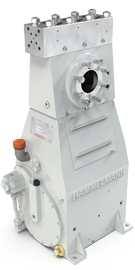
The traditional stuffing box design cannot contain ultra-fine molecules like hydrogen or highly penetrating fluids like methanol under high pressure. To eliminate fugitive emissions, the prime mover must utilise specialised containment mechanics.
As the UK agent for Hammelmann, Calder integrates the Hammelmann HamPro pump series into our zero-emission packages. HamPro vertical plunger pumps are purpose-built for green technology and hazardous process applications. Instead of relying on friction-based packing, they utilise friction-free hydrodynamic labyrinth seals to trap volatile gases and liquids. This eliminates the mechanical wear that leads to seal degradation, providing a zero-emission fluid end capable of handling severe operational demands without uncontrolled fluids escaping to atmosphere..
2. Integrating Pressurised Barrier Fluid Systems
Even the most advanced pump seal is only as reliable as the system supporting it. To guarantee zero outward leakage, the pump package requires an engineered barrier.
We design and integrate pressurised barrier fluid systems directly onto the Calder skid. These systems circulate an inert barrier fluid at a pressure deliberately maintained higher than the process pressure. If any fluid transfer occurs across the seal face, the inert barrier fluid moves inward into the process. The lethal ammonia, explosive hydrogen, or flammable methanol can never escape outward into the atmosphere. A controlled containment is in place.
3. Selecting Specific, Advanced Metallurgy
Hazardous fluids attack standard metals. Hydrogen causes rapid embrittlement by attacking grain boundaries, while ammonia and methanol present severe corrosive challenges. Solving the seal issue is useless if the surrounding pipework and pressure-containing components crack under pressure.
Zero-emission containment requires strict material selection across every wetted component. While the Hammelmann HamPro fluid ends are manufactured from specialised high-alloy stainless steels, Calder engineers apply the exact same metallurgical standards to the entire package. Every piece of suction and discharge pipework, pulsation dampener, and inline valve is specified to resist the exact chemical degradation of the pumped fluid, ensuring the containment boundary remains intact over the 20-year lifecycle of the package.
4. Utilising Magnetic Drive Pumps
Depending on the application, Calder engineers will evaluate the inlet conditions and select a feed pump accordingly. Where process parameters allow, we can specify magnetic drive pumps. By using magnetic coupling rather than a traditional pump shaft, mag-drive systems completely eliminate the need for an external dynamic seal, removing the primary leak path altogether. For higher pressure applications that exceed mag-drive capabilities, we turn to specialised multistage and reciprocating technology.
5. Inert Gas Blanketing of Controlled Leakage
Even with high-precision containment mechanics, managing controlled weepage is a critical safety requirement for high-pressure applications. To address this, Calder can use inert gas blanketing systems. A continuous flow or pressurised blanket of inert gas – typically nitrogen – is used to blanket and purge the seal chambers. This prevents explosive or toxic concentrations of hydrogen, ammonia, or methanol from ever forming within the housing. The blanketing system safely carries any trace fugitive emissions away to a site’s designated flare, scrubber, or recovery system. This ensures the immediate atmosphere around the Calder skid remains entirely uncontaminated and perfectly safe for site personnel.
Proven Before Shipment
Zero-emission claims must be backed by physical evidence before the equipment arrives on site. At our dedicated testing facility in Worcester, UK, we conduct full mechanical run tests on the fully assembled package. We test the barrier fluid system pressures and validate the ATEX instrumentation under load, proving total containment before the skid ships.
To discuss zero-emission pump packaging for your next energy transition or offshore project, contact the Calder engineering team.