

Cleaning Industrial Tubes with High Pressure Water
High pressure water is a safe and efficient way to effectively clean industrial tubes.
Industrial tubes are a critical part of heat exchangers, condensers, chillers, and process equipment across a variety of industries, including pharmaceutical, food and beverage, and petrochemical facilities. Over time, deposits such as scale, biofilm, process residues, and fouling can reduce heat transfer efficiency, restrict flow, and compromise hygiene or process performance. Regular cleaning is essential to maintain efficiency, product quality, and equipment lifespan. At the heart of tube cleaning is high pressure water which is the most effective ‘how’ for removing stubborn deposits from inside tubes without damaging the tube surface. The water’s velocity and pressure dislodge scale, biofilm, and residues while flushing them out of the tube, achieving a thorough clean. In sanitary industries, this method avoids harsh chemicals, maintains hygiene, and can be precisely controlled for sensitive materials.
Tube Cleaning has Evolved
Tube cleaning in industrial settings has evolved significantly. Traditional hand lancing – where operators manually insert a flexible lance or nozzle into each tube – is still possible, but it is labour intensive, physically demanding, and exposes operators to high pressure hazards. Today, most facilities use semi-automatic or robotic tube cleaning equipment, which greatly improves operator safety, reduces fatigue, increases efficiency, and ensures consistent cleaning results.
When Tube Cleaning Is Required
Tubes should be cleaned when:
- Heat transfer efficiency drops or energy consumption rises.
- Flow rates fall below design requirements.
- Sanitary standards require internal cleanliness (e.g., pharmaceutical or food & beverage applications).
- Deposits are identified during inspections in petrochemical and other process industries.
Choosing the Right Tube Cleaning Equipment
The most efficient method of cleaning tube bundles is a rigid lance system. During a plant maintenance shutdown, heat exchangers are removed and taken to a wash bay. Multiple (up to 5) rigid lances are used simultaneously to give efficient and thorough cleaning performance.
In some instances, unexpected loss of heat exchanger performance requires immediate attention. Flexible lance systems can allow in-situ cleaning without pulling the complete tube bundle, saving significant downtime.
1. Bundle Pulling and Extraction
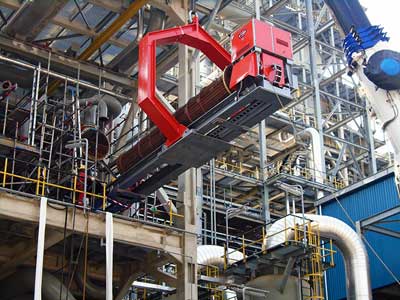
Aerial and truck-mounted bundle pullers allow for the complete removal of tube bundles. The BundlePro range includes self-balancing heat exchanger extractors from 5 tonnes to 100 tonnes, and bundle movers.
2. Rigid Lance Systems
Once at the wash bay, the operator controls the jetting operations remotely. For shutdowns and turnarounds, the rigid lance systems offer the safest and most efficient performance.
- Improved operator safety: Reduces exposure to high pressure jets, contamination, and heavy equipment.
- Multi-lance cleaning: Up to five tubes can be cleaned simultaneously.
- Consistent cleaning: Controlled lance movement speeds ensure uniform removal of deposits along the tube length.
- Reduced operator fatigue: Robotic machines handle the lance and jetting, allowing operators to control the process remotely.
- Faster and more efficient cleaning: Ideal for high-volume operations or long tube bundles.
- Higher power/high flow combinations: are possible using automated tube cleaning technology.
3. Flexible Lance Systems
Flexible lance systems are commonly used across pharmaceutical, food & beverage, and petrochemical applications. They navigate long or U-shaped tubes and allow in-situ cleaning without complete bundle removal. This reduces downtime and eliminates the need for disassembly in large or complex units. As well as shell and tube exchangers, these systems are ideal for use with single tubes and small diameter pipes. For larger diameters, pipework cleaning systems are available.
Today’s increased safety flexible lance systems have largely replaced traditional flexi-line manual hand lancing in industrial facilities and plants. Benefits include:
- Improved operator safety: Reduces exposure to high pressure jets.
- Consistent cleaning: Controlled lance movement speeds ensure uniform removal of deposits along the tube length.
4. Ancillary Tools and Nozzles
A range of high pressure nozzles, rotating or fixed, can be selected to match tube diameter, fouling type, and material. For flexible lancing, accessories such as hose reels, indexing fixtures, and remote controls improve safety and operational efficiency.
5. Pump Systems
Both the rigid and flexible lance options use a pump unit to supply the water at high pressure. These are generally powered by either diesel or electric.
- Diesel Engine Powered: Mounted on road-going running gear and ideal for multi-site operations. This is the preferred option for industrial services contractors that mobilise their equipment for site works.
- Electric Motor Powered: Often used for fixed or semi-permanent installations inside a building. Alternatively, it is mounted outside with an environmental enclosure. This type of unit is normally owned by the factory owner or refinery.
Industries Served
- Pharmaceutical and Food & Beverage: High-purity fluids and hygienic standards demand precise cleaning and strict process compliance.
- Petrochemical and Energy: Large-scale heat exchangers and process units require cleaning with semi-automatic or robotic systems to maintain efficiency and safety.
Frequently Asked Questions
Q: Can tubes be cleaned without removing the bundle?
Yes. Flexible lance systems allow in-situ cleaning for most applications, reaching long or difficult-to-access bundles without disassembly. This is particularly valuable in petrochemical plants, where downtime is expensive, and in food and beverage or pharmaceutical facilities, where hygiene and process continuity are critical.
Q: Why choose semi-automatic equipment over hand held tube cleaning?
Semi-automatic systems provide greater safety, comfort, and repeatable results. Operators are less exposed to high pressure hazards, cleaning is more consistent, and fatigue is significantly reduced, allowing large or complex tube bundles to be cleaned efficiently.
Q: If I clean tube bundles in situ without pulling the bundle, what happens to the waste water and debris? Where does it go?
A range of suitable water control methods and workplace safety solutions are available. Safety funnels can be attached to the rear of the tube bundle to prevent damage to nearby equipment, reduce waterjet noise, and allow collection of spent water.
Need More Information?
If you would like to discuss your requirements, please contact our team. Call +44 1905 751790 or email sales@calder.co.uk.
Alternatively, check out Jetting360. This is an opportunity to see our tube cleaning accessories and pump units during a visit to our factory tailored to your requirements.


