
Two bespoke well service pump skids will soon be heading off to their platform in the North Atlantic. There they will be assembled as one twin-pump skid.
Capable of pumping 1000 litres per minute (60 cubic metres per hour) at 517 bar, they really are beasts. Each unit has a motor powering a well-service style positive displacement pump. We have used these for many of our well service pump packages over many years and have found them to be a particularly reliable workhorse, easy to maintain, and they have a long service interval.

The twin pump unit will be used for cuttings re-injection and well service fluids injection and is sour service compatible. The package is compliant with Canadian CSA standards.
It is always pleasing when working on a project for a returning customer. Having built well service pump packages for this customer previously, it is great to know they have once again put their faith in our company.
Pump Skid Design, Build, Test, and Commissioning
All design, build and testing was carried out here at our factory in Worcester, UK.
Design
A typical skid layout, but still with many design considerations. Footprint and access were the first issues. As the unit is for an existing and operational platform, the footprint was fixed and the access limited. The skid has been designed to be disassembled after testing and re-assembled on site.
Whilst the layout may look similar to many of the well service skids we build, the design has to follow the hazardous area standards for the operating location – in this case CSA. Then there is, of course, the customer’s own standards and specifications.
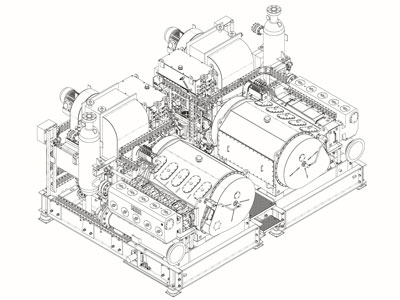
So the design is the foundation for a compact, modular, and compliant pump package. Given that everything is carried out at one factory in Worcester, the design team follow the progress through the build and testing. Regular face-to-face meetings take place between the design, build and test teams which means issues are identified and addressed promptly.
Build
With the arrival of the pumps, the build started in earnest.
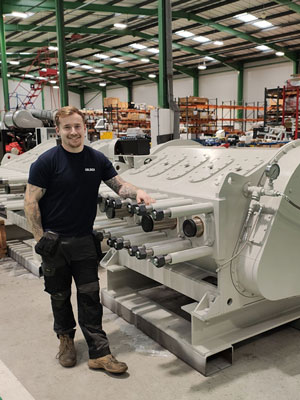
To achieve the required modular design, the baseframe is bolted rather than fully welded. The baseframe assembly and accurate set-up is, therefore, fundamental to the build. And that is just one of the areas where the experience of Jake and the team is so valuable.
All aspects of the build are important, but motor/pump alignment is crucial to ensure smooth operation and equipment longevity. Coupling manufacturers recommend maximum tolerances on alignment of rotating equipment. However, to achieve greater levels of accuracy, we typically work to less than half the recommended tolerance.
Once the mechanical team finish, the electricians move in.
Test
As with all pump units built by Calder, after build completion the next task is thorough testing. We have test bays built specifically for the testing of large, powerful pump packages. The set-up for these very powerful pump units was a significant task in itself.
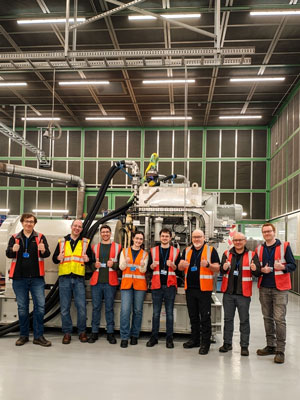
Our customer witnessed both the pre-F.A.T. inspections and the testing. And it would be fair to say from the thumbs-up in the photo that they were pleased with the results.
Commissioning
Already in the diary are the dates for commissioning. We will be there to support our customer both during commissioning and after. Commissioning tends to take one of two forms. Either we send a commissioning engineer to supervise the on-site re-assembly and commissioning by the customer, or we send a team to do it all ourselves. Our commissioning and service teams are also based in Worcester, so they are able to follow the build progress and meet the customer during testing. This familiarity with the project is hugely beneficial to the team.
Contact Us
To talk through your well service project, please call +44 1905 751790. Alternatively, email sales@calder.co.uk
